


Helwan University strives to be a leading educational and research institution in technology and the arts, and excels in education and sciences according to international quality standards
- Visits 2734956
Capital University (Formerly Helwan University) Hosts the Supreme Council for Education and Student Affairs Meeting
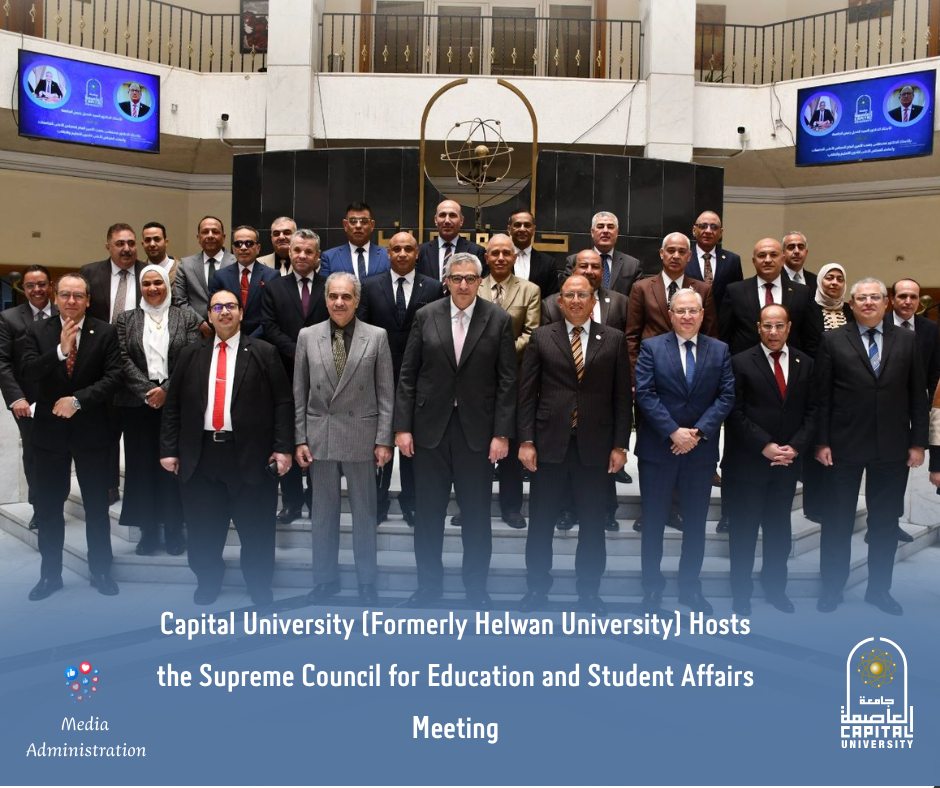
As part of the pivotal role played by Egyptian universities in developing the higher education system, Capital University (formerly Helwan University), under the patronage of Prof. El-Sayed Kandil, President of the University, and led by Prof. Hossam Refaei, Vice President for Education and Student Affairs, hosted on Thursday, February 12, 2026, the 120th session of the Supreme Council for Education and Student Affairs at the university’s headquarters.
In his remarks, Prof. Mostafa Refaat, Secretary of the Supreme Council of Universities, congratulated Prof. El-Sayed Kandil on the tangible achievements accomplished during the past period, praising his distinguished leadership skills and refined artistic sense. He emphasized that this unique blend of conscious leadership and creative vision has enabled the university to efficiently address numerous challenges, resulting in a qualitative leap and noticeable development across various academic and administrative sectors.
Prof. Refaat noted that the Supreme Council of Universities operates according to a clear strategic vision aimed at strengthening integration between Egyptian universities and various industrial sectors, thereby achieving genuine alignment between educational outcomes and labor market needs. He explained that the current phase requires reconsidering academic tracks and specializations in line with the rapidly evolving local, regional, and international job markets.
He stressed the importance of developing curricula and courses to become more flexible and up to date, with the possibility of dividing them into progressive learning stages and micro-credentials, enabling students to acquire specific skills within short timeframes and enhance their career opportunities. He added that many universities have already begun preparing compact educational packages that directly respond to industrial sector needs, contributing to the preparation of qualified cadres capable of meeting development requirements.
He further emphasized the necessity of supporting frameworks for university education development and moving beyond traditional models by adopting innovative and non-conventional educational approaches, while continuously reviewing the latest global trends and experiences in higher education and scientific research. He highlighted the importance of selecting approaches that align with national identity and culture and adapting them to serve the country’s developmental goals.
He concluded by affirming that developing the higher education and scientific research system represents a fundamental pillar for advancing toward broader horizons of progress and innovation, noting that cooperation and integration between universities and industrial and research institutions will form the cornerstone of building a modern educational system capable of regional and international competitiveness.
Prof. El-Sayed Kandil, President of Capital University, welcomed the members of the Supreme Council for Education and Student Affairs, expressing his sincere appreciation to Dr. Mohamed Ayman Ashour for his dedicated efforts during his tenure as Minister of Higher Education and Scientific Research and for establishing an ambitious strategic plan that contributed to system development. He also congratulated Dr. Abdel Aziz Konsowa on assuming the position of Minister of Higher Education and Scientific Research, wishing him continued success in completing the development journey and advancing the sector.
The University President affirmed that most Egyptian universities are currently classified as first-generation universities, which necessitates serious efforts to transition toward fourth-generation universities in alignment with global changes and the requirements of the Fourth Industrial Revolution. He explained that this transformation requires shifting the educational philosophy from rote learning to active learning, placing the student at the center of the educational process and enabling them to conduct research, analyze, and independently acquire skills.
He highlighted the importance of transforming the university textbook into interactive digital content that clearly defines what students study and the knowledge and skills they acquire according to each specialization’s requirements. In this context, he noted that the Supreme Council of Universities has successfully established a unified electronic platform through which educational services have been uploaded, facilitating students’ access to various academic and administrative services.
He added that the university seeks to support faculty members, emphasizing the necessity for each professor to have a dedicated electronic reference converted into a digital book available via the Supreme Council of Universities platform, ensuring standardized and modern academic content quality.
Regarding student skill development, Prof. Kandil explained that Capital University is preparing students for the labor market by assessing their skills through specialized tests and organizing online training courses via the electronic platform, enabling them to acquire essential digital technological tools and job-ready competencies prior to graduation.
He affirmed that within four to five years, the university aims to become a fourth-generation institution by developing the electronic examination system, upgrading infrastructure, and equipping lecture halls and laboratories with modern technologies to ensure educational quality. He stressed that quality assurance represents the central goal during the current phase, with efforts directed toward accrediting all academic programs and pursuing international accreditation.
He also highlighted the university’s strong focus on student activities, which has been crowned by achieving first place – Gold Category – in student activities. Additionally, he emphasized the special attention given to international students within the university’s strategy for expansion and global engagement.
He concluded by affirming that the university is currently witnessing a significant leap in development, digitalization, and digital transformation, reflecting a clear vision toward building a modern university capable of local and international competitiveness and graduating qualified cadres aligned with future demands.
Prof. Hossam Refaei, Vice President for Education and Student Affairs, stated that the council discussed several strategic topics aimed at enhancing the quality of educational and student services. These included reviewing universities’ efforts to address behavioral deviations by incorporating the Ministry of Higher Education’s strategic plan axes on the student activities registration website, presenting a documentary video on anti-bullying initiatives, following up on committee reports concerning the improvement of services in university dormitories, defining clear mechanisms for admitting inclusive education students, studying the technical and logistical aspects of implementing anti-drug programs, and discussing the integrated executive plan for 2026/2027 related to the National Population and Development Strategy.
The meeting also witnessed the launch of several important initiatives and events, including: a translation competition for Egyptian university students under the initiative “History Through Egyptian Eyes,” in cooperation with the Ministry of Defense represented by the Popular and Military Defense Forces, to promote national awareness and correct historical narratives; the announcement of organizing the 12th Summit Forum for the Ideal Male and Female Student Competition and the 5th “Goodwill Ambassadors for People of Determination” Forum in April 2026; adopting Alexandria University’s Code of Ethical and Behavioral Standards for Students as a model for Egyptian universities; and discussing proposals to unify the naming of psychological, social support, and family counseling centers and approve their policies and procedures manual.
Participants affirmed that Capital University’s (formerly Helwan University) hosting of this meeting reflects its distinguished standing among Egyptian universities and its active role in supporting educational and student-related issues. They noted that the university represents a model of openness to societal concerns and adoption of national initiatives contributing to building a conscious generation capable of leading the future.
The meeting concluded by emphasizing the importance of intensifying cooperation between universities and various national entities to strengthen the role of higher education in serving Egyptian society and achieving sustainable development goals.
#Media_Administration
#General_Department_of_Public_Relations_and_Media
#Capital_University
#Be_Unique
#BE_UNiQUE_WITH_CU
Helwan University strives to be a leading educational and research institution in technology and the arts, and excels in education and sciences according to international quality standards